
The scapegoat.
During the month of Tishri, Jews throughout the world observe “Yom Kippur”, thus bringing to a close a period of ten days devoted to personal self-examination and repentance. During the “Sabbath of Sabbaths” (Shabbat Shabbaton), it is customary to read a passage from Leviticus 16 describing a sacrificial and expiatory rite known in our language as the “scapegoat”.
He (Aaron) shall take the two goats and set them before the Lord at the entrance of the Tent of Meeting. Aaron shall cast lots upon the two goats, one lot for the Lord and one lot for Azazel. Aaron shall bring forward the goat upon which the lot for the Lord fell, and shall offer it as a sin offering. But the goat upon which the lot for Azazel fell shall be presented alive before the Lord, to make atonement over it, that it may be sent away into the wilderness for Azazel. Lev. 16:7-10
The meaning of this expression, sometimes misused, implicitly refers to a notion of transferring evil onto persons or objects, as the anthropologist James Frazer set out in The Golden Bough[1]. Frazer left behind a monumental body of comparative work. Although his studies on the transfer of evil were considered authoritative for many years, he nonetheless failed to discern the metaphysical and ethical elements around which this rite is structured.
The expression “scapegoat”, attested in France as early as 1690 with an identical definition, was later taken up in connection with the Dreyfus Affair. “Such is the historical role of the Dreyfus Affair. Upon this scapegoat of Judaism, all the ancient crimes are found representatively accumulated.”[2]
The modern understanding of this expression arises at once from a literal reading of the expiatory rite described in Leviticus and from an ignorance of the ontological and ethical principles proclaimed by the Bible and by Judaism.
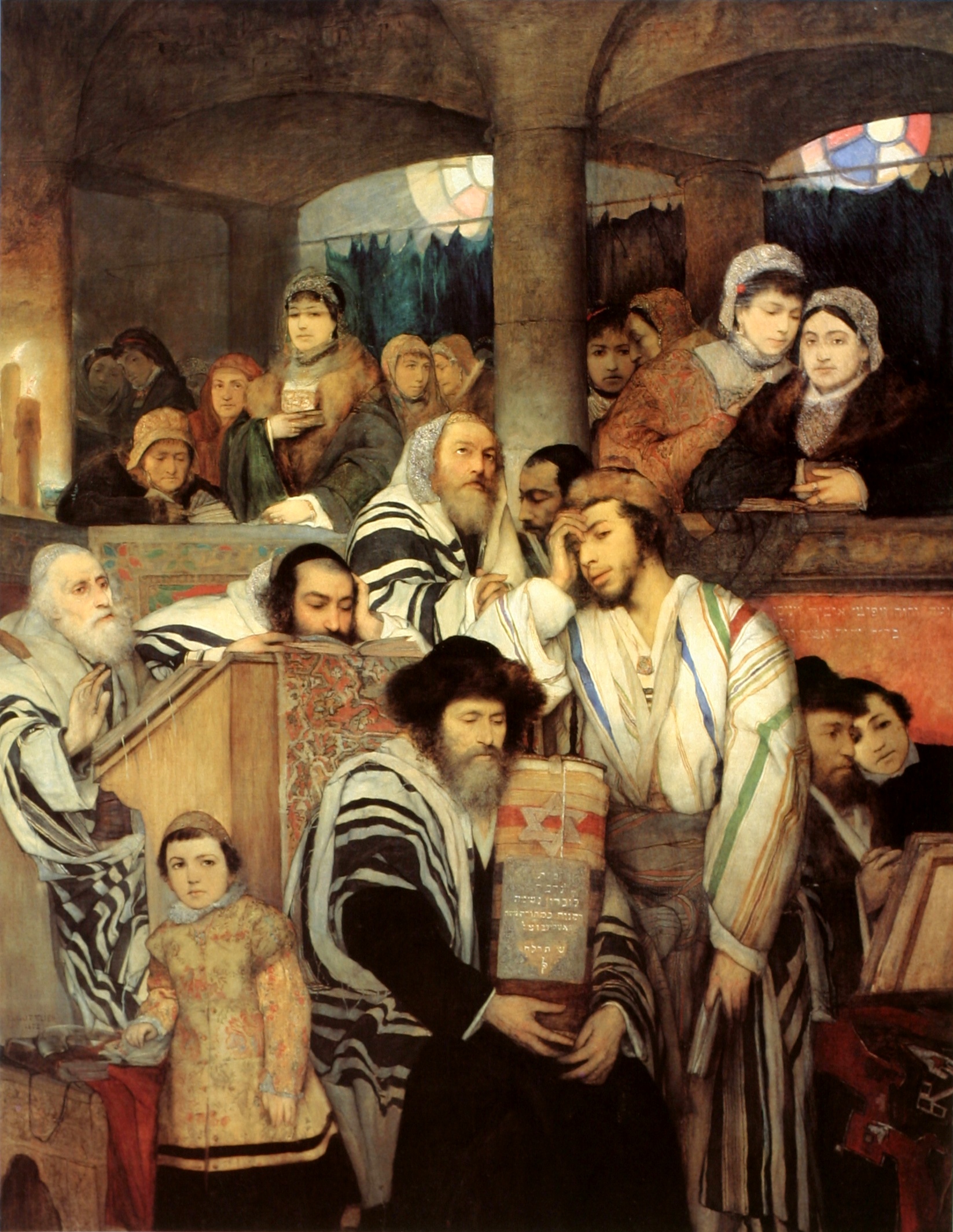
Gottlieb – Jews Praying in the Synagogue on Yom Kippur
It is worth noting that the expression “scapegoat” does not appear in the Bible. The phrase “caper emissarius” comes from ecclesiastical Latin, from a rendering in the Vulgate. In this respect, that translation expresses concepts which are in part exogenous to the Jewish tradition.
The ethnologist Carlos Castaneda rightly maintained that the second ring of power is “intention”. All hermeneutical work consists in recovering intention, which is almost never disclosed in texts.
What was the intention of the biblical redactors who transmitted this ritual to us with such force of detail, and what might its spiritual content have been?
Before answering this question, we must contend with an apparent contradiction which also constitutes a first hermeneutical key.
How can Judaism, which proclaims itself monistic, refer within a rite to concepts as clearly dualistic as those implied by the scapegoat?
How are we to move beyond the contradiction between the “Shema”[3], which proclaims absolute unity, and the apparent dualism typified by the two goats, one sacrificed and the other bearing upon its back the whole of Israel’s peccant conduct?
The deciphering of a rite cannot be merely a stylistic exercise. It must enable the one who undertakes it to extract a spiritual teaching and, by way of consequence, a praxis.
Yet before attempting to bring its content to light, we must seek to understand the transversal purpose of most rites. As the comparativist Mircea Eliade showed, a ritual has, among its functions, that of effecting a rupture in “profane” time, so that “religious man” may recover, within that temporal space, the primordial mythical time made present[4].
There is scarcely any ritual that escapes this definition. The rite of Shabbat[5], for example, effects, as its Hebrew name indicates, a separation between profane time and sacred time. Its spiritual, ethical, and metaphysical content is to be found in Genesis, since it ritualises, through incessant repetition, the “Shabbat” of the Eternal Being who has entrusted to human beings the responsibility for the world to come.
We have asserted that the impossibility of any rupture in the unity of the Eternal Being constitutes the first hermeneutical key of the Bible. Another hermeneutical key particularly well suited to the analysis of a ritual is typology[6].
Accordingly, this sacrificial rite commemorated events and archetypes prior to their codification in Leviticus. To which events were the ancient Hebrews referring in Leviticus 16?
Our attempt to decipher the rite brings to light certain salient elements:
- The universalisation of consciousness through the ordeal of the iniquitous aggression of the righteous man, typified by the casting of lots for the goat to be sacrificed. The holocaust not being the consequence of an objective and reasoned choice on the part of the sacrificer (Lev. 16:7)[7].
- Excommunication[8].
- The unity of the community of human beings with ethics.
- The eternity of truth as a predicate of the Eternal Being.
The codification of the rite referring to archetypes, and the Bible making extensive use of typology, several passages of the Torah may be brought into relation with the rite of Leviticus 16 setting forth sacrifice, wandering, and excommunication. One may point, for example, to the sacrifice of Abraham, but above all to the murder of Abel by Cain.
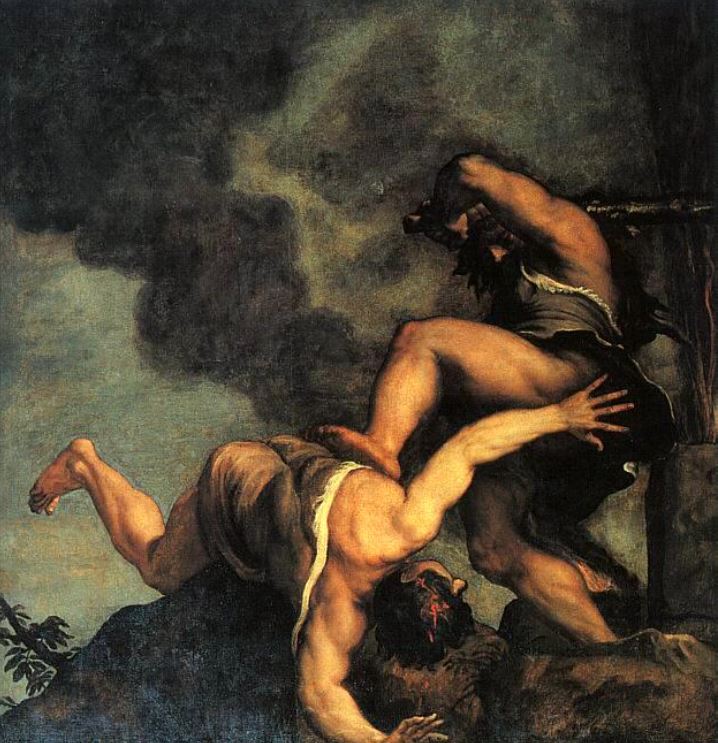
Abel and Cain, Titian, Santa Maria della Salute, Venice
Just as the lot falls upon the goat destined to be sacrificed, the Bible remains silent as to the reasons that led the Eternal Being not to accept Cain’s offering. Although many Jewish and Christian interpretations agree in asserting that Abel possessed spiritual dispositions superior to those of Cain, it nonetheless remains true that the primordial murder rests above all upon Cain’s inability to govern his own desires. The indifference of the Eternal Being towards Cain’s offering will lead him into a fatal anger, and he will unjustly murder his own brother, Abel. The observance of Kippur is moreover largely centred upon reflection concerning the governance of our desires (cf. Gen. 4:6 and 7)[9].
The study of the primordial murder committed by Cain offers reflections of considerable reach. His act, and then the punishment inflicted by the Eternal, inform us of the consequences of transgressing ethical rules, of our responsibility for our actions, and of the notion of forgiveness as it is set forth in the Bible.
The Eternal Being does not forgive faults. In this respect, the Jewish conception of forgiveness differs from that proposed by Christianity. Jewish teaching holds that forgiveness can be obtained only from the victim. The response to aggression is certainly not to retaliate, but above all to excommunicate the one who committed the fault, so that, alone in the secrecy of his conscience, he may reflect upon the ethical dimension of his acts. The Eternal Being will moreover apply this rule to Cain by placing upon him a sign (ot), so that no one may set in motion a deadly spiral of violence, and by imposing excommunication upon him, condemning him to be a wanderer and a fugitive.
The story of the primordial murder calls for a parenthesis whose conclusions may be addressed both to political advocates of capital punishment and to those who uphold a theocratic conception of society. Both develop the notion that it would be acceptable to kill in the name of a higher principle, whether temporal or religious. Yet this idea finds no metaphysical or ethical justification. In the particular case of the biblical text, one can never recall strongly enough that not only is the condemnation of murder unequivocal (a condemnation that will later be confirmed in the Torah as one of the Ten Words), but also that the response to this crime, to this fatal transgression of ethical rules, cannot be the death penalty, whose mortiferous effects were identified from the highest antiquity. This parenthesis seemed all the more indispensable in that it also introduces a central hermeneutical rule which, if correctly understood, excludes any strictly literal interpretation. If the Bible sets forth human transgressions that anyone may observe in ordinary life, it in no way endorses them. It delivers only normative strategies in which the primacy of ethical conduct remains the one and only acceptable path for maintaining peace among the various components of the human community.
Excommunication as a path of descent into oneself must not, however, be confused with the expulsion of the goat towards Azazel. The rite, as we have indicated, had a cathartic value, sensitising the ancient Hebrews to the consequences of transgressing ethical conduct.
Two principal transgressions have ceaselessly caused humanity to fall since the dawn of emergent consciousness: murder, by its irreversible nature, and the iniquitous exclusion of one’s neighbour. Social exclusion is another form of aggression against the righteous.
Indeed, human beings, in so far as they all belong to the same species notwithstanding their ethnic differences, spiritual orientations, and sexual inclinations, owe one another at the very least mutual respect, since they are constrained to live together. The Bible abounds in descriptions of such situations of iniquitous exclusion (the exclusion of Hagar and Ishmael, for example). Thus, by simulating on the one hand the murder and on the other the unjust exclusion of the righteous, the scapegoat rite had the function of bringing the ancient Hebrews to reflect upon the two crimes of which all human beings may be guilty, and whose consequences inevitably bring about the fracturing of societies.
Abel symbolises, like the goat sacrificed by lot, the persecuted righteous man whose consciousness is universalised in the light of the ordeal of aggression and iniquity. It is indeed a universal rule that most human beings, oriented above all towards themselves and the everydayness of material life, become sensitive to the human condition only in the light of their own personal trials. By codifying the story of Abel, unjustly murdered by his own brother, and that of the goat upon which the lot falls so that it may be sacrificed, the Bible intends to make us aware that there is no human community without ethics, and that the rupture of this unity between the Eternal Being and ethics is a fundamental constituent of the fall of every human society (cf. Lev. 19:18).
Finally, the sacrificial ritual, in so far as it is an analogon of the primordial murder, informs us about truth as a predicate of the Eternal Being. What is not true cannot be conceived on the ontological plane. The column of smoke of the holocaust (“olah”, “the ascent” in Hebrew) certainly symbolised the elevation of the universalised consciousness of the persecuted righteous man, yet it also recalls, with due justice, the voice of the blood of Abel’s primordial murder rising up to the Eternal Being (Gen. 4:10).
This rising voice of blood teaches us at once the futility of attempting to conceal committed deeds, and that the property of truth is to come to light sooner or later. This archetype of the revelation of truths as one of the constitutive nuclei of the Eternal Being is moreover taken up in almost the same terms in the account of Moses’ killing of the Egyptian[10].
The perception of the world under the form of duality is an inward, properly human illusion, as Martin Buber remarks in Judaism. In the constant concern for return to unity advocated by Judaism, decision constitutes the only true choice offered to humanity. In other words, it is by performing ethical acts unconditioned by the materiality of everyday life that this return to unity proposed by Teshuvah[11] becomes possible.
Thus the passage of Leviticus 16, if it is not interpreted through an illusory duality, is far from absolving humanity of its faults through a supposed transfer of evil. On the contrary, it confronts us with responsibility for all our acts, each of which makes history.
Jean-Marc Cavalier Lachgar.
Sept 2004
[1] See the volume devoted to the scapegoat.
[2] Cf. the Wikipedia encyclopaedia.
[3] “Shema’ Yisrael Adonai Elohenu Adonai echad” – “Hear, O Israel: the Lord our God, the Lord is One” (Deut. 6:4).
[4] M. Eliade, The Sacred and the Profane, p. 122, Folio edition.
[5] Shabbat, literally “cessation”.
[6] Typology was defined by Eliezer ben Yose Ha-Gelili around the third century of our era as the twenty-seventh hermeneutical rule. Typology is the consequence of history, by which individuals and events incessantly reproduce the same archetypes.
[7] Louis Segond translation.
[8] Excommunication is understood here as isolation from human society, and certainly not as the sentence of an ecclesiastical tribunal.
[9] Genesis 4:6–7, Louis Segond translation.
[10] Exodus 2:11–15.
[11] Teshuvah, “the return to God”.