
Authority of the king in the bible
Article published in the journal Maayan PESACH 5767 of the CJL
To attempt a reflection on the authority of the king in the TaNaKh is to question the ontological character of the head of state. Our purpose cannot claim to be exhaustive, particularly from the standpoint of political systems, so diverse were the experiences in this field throughout the history of humanity and of cultures. The concept of the state is a modern notion which admits of no comparison between our perception of the state and the idea that the ancients might have formed of the principle of nationi. All comparisons set aside at the strict level of political forms, there remains a transversal principle shared by the quasi-totality of human societies, from the most politically organised to the most traditional. This principle lies in the nature of the bonds between the people and their leaders. We shall therefore take an interest in the universal character of the nature of this relationship. The notable parenthesis of the modern experience of anarchy, which, as its Greek etymology indicates (an-archos), claimed at one and the same time the construction of a model of society without authority, power, domination or hierarchical relationship between men, and at the same time affirmed the refusal of any first cause, pleading the primacy of the principle of diversity over that of unity. This experience must not cause us to forget that there has never existed, and still does not exist, any human society without leaders. It is not the purpose of an article as synthetic as this to examine the origin of the legitimacy of power, although the TaNaKh makes extensive mention of it by centring that legitimacy around three themes directly connected with the periods during which it was written. These three themes in the time of the patriarchs are the right of primogeniture conferring legitimate power, the given state of situations, and the given state of individualsii.
Two guiding principles, consubstantial to Judaism from its most distant origins, must guide any attempt at hermeneutics. These two principles are the unequivocal affirmation of a principle of unity of the world (henology) and the affirmation of the social and spiritual virtues arising from submission to the law. Indeed, Judaism cannot conceive of a model of human society in anomie and outside an indivisible principle of unity.
The TaNaKh posits, from “Berechit” onwards, the existence of principles of henology: the unity of man with the cosmos, the absolute unity of the human species, unity between men, respect for ethics having as an implicit consequence a principle of unity between men and their leaders. At the heart of discerning the principle of unity lies the understanding of the ontological role of the leaders of the people or heads of states. Long before the establishment of a monarchy in Israel, it is appropriate to pause for a moment on the role of Moses. Moses, prince of Egypt, prophet of the law of the Eternal, embodies alone the whole Hebrew people in its diversity. He is the holder of both temporal and spiritual power. He also established a principle which should never have been contradicted throughout human history, namely the legitimacy of the leader of the people as the holder of temporal and spiritual powersiii, even if the leader of the people delegated the administration of the sacred to a high priest, as he did with his brother Aaron.
The verse of Exodus 4:16 is unequivocal on this point “He (Aaron) shall speak for you to the people; thus he shall serve as your mouth, and you shall serve as his inspiration.”
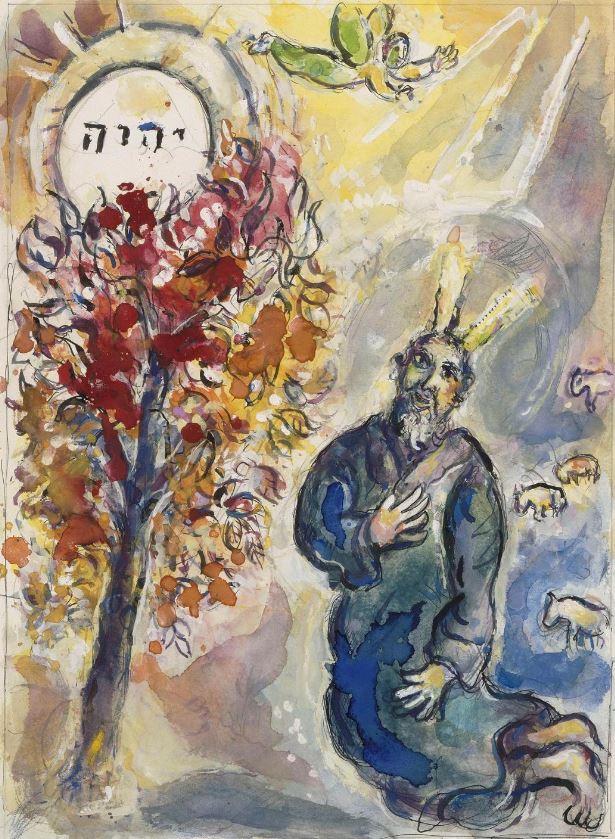
Marc Chagall, Moses and the Burning Bush.
This verse sets out explicitly the role expected of a leader of the people who must ensure the reign of justice and the respect of ethical principles, which we formulate today in modern terms as the social cohesion of the nation.
Indeed, no human society can subsist for very long while denying ethical principles. The role of the leader of the people or head of state as the inspirer of ethical principles is found on several occasions in the TaNaKh. The fact that the leader of the people and later the king embodies the inspiration of spiritual, ethical and ontological principles is symbolised by the rite of anointing conferring, in the eyes of the people, the legitimacy of the monarch.
It is not rare that the TaNaKhiv has strongly influenced external cultures. The rite of anointing is one of the most significant examples, since Christian monarchies were anointed by priests, thereby borrowing this tradition directly from the TaNaKh. There is reason to take an interest in this rite. The kings of Israel were anointed; this ceremony marked the act of legitimising heads of state in the eyes of the people. It was not practised, as some would have it, solely by priests, but initially represented the act of transferring power from one monarch to his successor, as was the case of King Saul, who was anointed by Samuel before being disavowed by the Eternal for having transgressed His law.
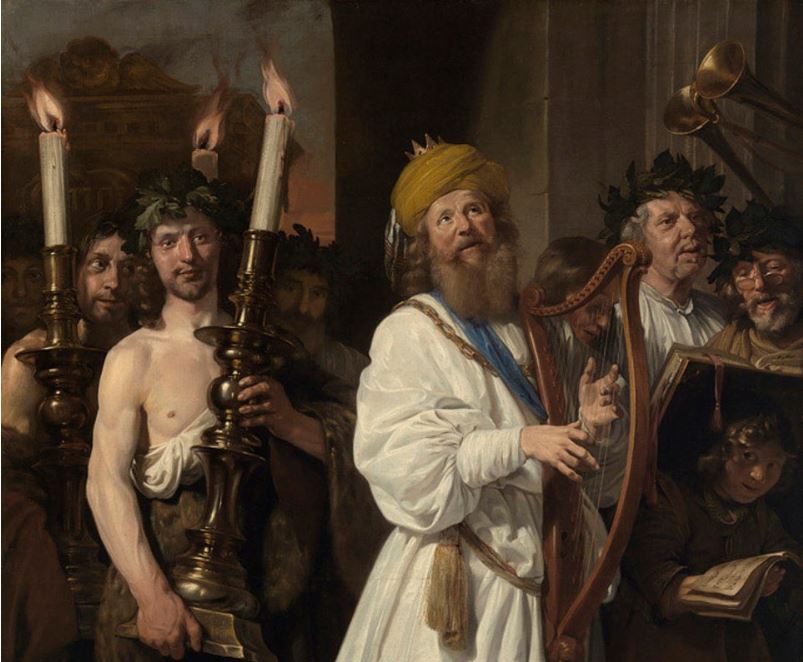
David playing the harp, Jan de Bray, 1670
The anointing performed by the high priest, the holder of the sole spiritual power, appears with Solomon. Indeed, King DAVID, dying and unable to perform this rite, entrusted this task to the high priest, communicating to his young son Solomon these words “I am about to go the way of all earthly things; be strong and show yourself a man! Faithfully obey the Eternal your God by walking faithfully in His ways, observing His laws, His commandments, His rules and His statutes, as they are written in the law of Moses, so that you may prosper in all your works and in all your undertakings” 1 Kings 2–3
The legitimacy of the authority of King David is entirely significant of the role of the head of state as the inspirer of the principles of the Eternal. Indeed, he was the only king to be anointed twice: once by the legitimate king, Samuel “And God said to Samuel: Go, anoint him; he is the one. And Samuel took the horn of oil and anointed him in the midst of his brothers; and from that day onwards, the divine spirit did not cease to animate DAVID” 1 Samuel 16–13 and then at Hebron by the chiefs of the Judean clans. “All the elders of Israel therefore came to the king at Hebron; King David made a covenant with them at Hebron, and they anointed him king of Israel” II Samuel 5–5
David’s second anointing is of interest in that it indicates for the first time, in filigree, a legitimisation of the function of the king by an oligarchy, in other words by the people.
Rabbinic literature and the Talmud are not silent on the role of the king or the leader of the people. Moses Maimonides devotes a lengthy development to the symbolism of the throne (kissé)v and to its comparison with the sanctuary, indicating that the throne can be occupied only “by men of distinction and greatness, such as kings, and that consequently it is a visible thing indicating the greatness of him who has been judged worthy of it (Guide for the Perplexed p 41”

The Judgement of Solomon, a classic theme in the history of art in which the king, holder of temporal power, must apply ethical principles.
This conception of the head of state as the inspirer and embodiment of principles has not only influenced the relationship of Jews with temporal power through the famous Talmudic formula “The law of the state is the law”, which we find in Ecclesiastes 8:2 “I say to you: Observe the king’s command, and do so because of the oath made to God.”, but also Western thought. Even in our own time we continue to hope in the ability of our heads of state (now most often elected) to embody ethical principles and to put them into practice for the good of all.
Jean-Marc CAVALIER LACHGAR
April 2007
Bibliography:
-The Guide for the Perplexed, Moses Maimonides, Verdier
-The Bible, Hebrew–French Translation, Hebrew text according to the Masoretic version under the direction of Chief Rabbi Zadoc Kahn, BIBLIEUROPE
-Moses, by Rabbi Daniel Jeremy Silver, Fayard
-The Talmud, A. Cohen, Payot.
i State and nation are two distinct notions, the state being a territory politically defended by a local power, as against the nation being the people inhabiting that territory and defended by that power. In Moses’ time there exists a people (nation) as well as a political power (executive, religious, and juridical), although the Hebrews do not yet have a territory (State). In this sense Moses may be described as leader of the people but not yet head of state. The status of head of state in Israel truly takes on its meaning only when the Hebrew people conquer the Promised Land of Canaan.
ii It would be appropriate to examine the origins of authority in the political regimes that followed the time of Moses. Moses’ personal spiritual vocation (revelation of YHVH through a certain number of stages listed in Exodus) invests Moses with his authority at a time when no one else among the people wishes to exercise this function: Moses has no rival; his sole difficulty is to convince the people of the possibility of fleeing Egypt, and to this end he will use the power of signs to accredit himself with the people, and above all to accredit his project of exodus and thus to have himself obeyed in this flight.
Period of the judges : it is the Spirit which, by taking hold of a human being, makes him a head of state and invests him with authority.
Period of the kings : it is the last judge (the then name of the head of state in Israel) Samuel who, when the people, looking towards the Egyptian model, are no longer satisfied with a judge but desire a king (with throne, crown, court, palace, etc.), finds himself obliged to satisfy the people by choosing, with divine counsel, a man capable of fulfilling this function: the future King Saul. But Saul, having been an unjust king, is disavowed by God and by Samuel (who no longer exercises anything but the function of high priest during Saul’s reign), and Samuel, with God’s counsel, then chooses another king: David. In the time of King David, whereas the right of primogeniture ought to be exercised (cf. in II Samuel 3:2–5 and 5:13–16 the lists of David’s sons in order of birth and which thus provide the order of the legitimate claimants to the reign, a younger son being able to reign only if his elders die or refuse the function: we see that Solomon occupies in these lists only one of the last places), the prophet Nathan and one of David’s last wives, Bathsheba, intrigue to make Bathsheba’s son, Solomon, the successor of David (thus in disregard of the right of primogeniture). Finally, after the schism of Israel into two distinct kingdoms, at the time when Alexander and his generals have conquered Palestine, which is then no more than a province of Alexander’s empire, and whereas the foreign, legal but illegitimate, dynasty of the Seleucids reigns over Palestine, it is the resistance of the Maccabean priests which invests them with authority to exercise a legitimate counter-power in Judea (some of these resistants to the occupier will even end by becoming high priests).
iii This lapidary remark calls for elucidation. The function of head of state implies, in order to exercise power, having ascendancy over the holders of spiritual power. This practice was clearly implemented in modern states, England being the most significant example since the head of state is also the head of the Church, thus preventing any external political influence by spiritual power. It is also interesting to note that even in very secular France, clearly separating powers, the President of the Republic is appointed honorary canon of the Church of Rome, thus conferring on him in principle a spiritual ascendancy over the majority confession. The constitution places, as tradition requires, spiritual power under the authority of the head of state. It would evidently be false to see in the delegation of the administration of the sacred to Aaron the equivalent of a political project of separation of “Church” and State in the modern form of the 1905 law. Nevertheless, one must never forget that Moses is also the guarantor of the diversity of the people who will go to the Promised Land. Indeed, among those who crossed the Jordan not all were Hebrews, as Genesis indicates without the slightest ambiguity in these terms: “A mixed multitude of all kinds went up with them; they also had large flocks of sheep and cattle”, thus indicating that Moses was the charismatic leader of a people necessarily plural on the ethnic plane, even if, according to the Bible, their descendants were aggregated to the Hebrews and finally merged among them.
iv This assertion would call for precision inasmuch as the TaNaKh precedes the Talmud. Yahwism (which begins in the time of the patriarchs and ends with the death of King Solomon) precedes Judaism (which appears from the death of Solomon at the time of the schism of Shechem which divides the Israelite state into two kingdoms, the northern kingdom called Israel and the southern kingdom called Judah: indeed, in so far as Yahwism, linked to the unique cult at the unique Temple of Jerusalem, the capital of the kingdom of Judah, could no longer administer religious life in Galilee and Samaria, the two provinces of the northern kingdom, this Yahwism is then limited to the sole kingdom of Judah which then gives it the name Judaism). The period of Judaism itself knows two successive periods which call for a distinction, a precision: there was first the Judaism of the Temple of Jerusalem which, after the destruction of the latter, will be followed by the Judaism of synagogues (synagogal).
v To be entirely exact, the throne had been conceived and elaborated by the ancient Egyptians on the basis of a symbolism (principally a cube surmounting a pedestal, the cube referring to the centre of the four cardinal points, symbol of the practice of obedience, and elevation upon a pedestal symbolising hope by which the self transcends its egoism in order to devote itself to the general interest), wholly relative to the great constitutive principles of the divine.