
MEMOIRE ET VIGILANCE
MEMORY AND VIGILANCE
“Bereshit” (in the beginning): with this word opens the very first book of the Tanakh. By opposing the Greek myth of eternal return with a beginning, by proclaiming the Sabbath of the Eternal and affirming that the future construction of the world lies solely in human hands, the Bible implicitly introduced two essential principles from which the West has never since departed:
Linear history and the responsibility of human beings in the construction of their own future.
Yet the Book of Genesis sets forth other universal principles. By deriving humanity from a single symbolic couple, the Bible enjoins us to recognise our fraternity in humanity, notwithstanding our cultural, ethnic, and spiritual differences. Every form of racism, exclusion, or fictitious superiority between peoples and nations is thereby rejected.
The first book of the Tanakh thus affirms, without equivocation, the absolute unity of the human species. This foundational principle of the three monotheistic religions, which today may fortunately appear to some as a truism, nonetheless did not prevent the emergence of iniquity, nor did it spare humanity from tearing itself apart, from the most ancient times, in fratricidal wars. The symbol of the wheel of time (typified, for example, in Hosea 8:7) announced the advent of “historical” humanity, conscious of shaping collective history through individual acts. Humanity was thus compelled to grant a new place to memory, in order to avoid reproducing past patterns that had repeatedly led to downfall and destruction. Judaism, and more specifically its rabbinic form, accords such importance to memory that it enabled a people long deprived of land to survive in the diaspora.
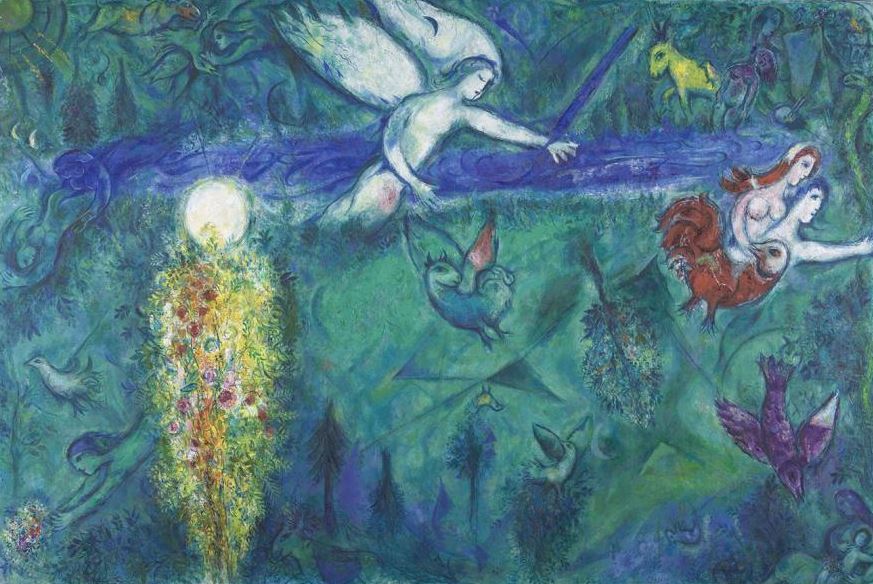
Adam and Eve expelled from the Garden of Eden. Marc CHAGALL.
Yet memory alone cannot ensure survival, nor can it prevent new forms of destruction without the necessary vigilance. At a time when demons that some naively believed to have been definitively eradicated are re-emerging, a time often described as “modern and civilised”, the work of memory is more relevant than ever. One of the most brilliant nations of Western Europe devised the most abominable plan of extermination against its fellow human beings.
The Shoah, arising within a modern nation that was in many respects a beacon of European culture, must already lead us to reflection. It is not the purpose of so concise an article to attempt an analysis of the complex causes of the Shoah, nor of anti-Judaism, antisemitism, or anti-Zionism.
One question, however, confronts us:
- How are we to transmit to future generations intangible principles capable of preventing the reproduction of patterns of destruction?
This essential question, when applied to the particular case of the Shoah, is further complicated by the advancing age of the survivors of the extermination camps. In the years to come, there will no longer be any living witnesses, and professional historians will then fully replace testimony in order to explicate this dark period of our history. Given that we are already unable to read simple floppy disks or punched tapes developed barely thirty years ago, it is highly likely that the digital and optical media commonly used today will be unreadable and unusable in centuries to come. The risk, even if slight, of rewriting history in favour of revisionist theses thus becomes real.
By deciding upon the programmed annihilation of the Jewish people, by denying to a portion of humanity—through indescribable crimes and humiliations—the very status of human beings for the sole reason that they were born, it was humanity as a whole that was rendered mortal. The men who coldly and without remorse murdered their fellow human beings had not been genetically programmed to become executioners, and yet they perpetrated the most abominable of crimes. These men lived in one of the most advanced nations in the world, economically, philosophically, and in the field of the human sciences. This leads us to affirm, paraphrasing Sam Braun, former deportee and honorary president of the Cercle Mémoire et Vigilance, that within every human being lies a dormant executioner, both for oneself and for others. One of the defining characteristics of the Shoah is silence. For those who adhere to a demiurgic vision, the Shoah was the silence of the Eternal. There is also the silence inspired by places of memory, where no words can describe the horrors and abominations that humanity inflicted upon itself through the Jewish people.
In Hebrew, the word “davar” also signifies action. Only speech that breaks the silence, transmitting to future generations intangible principles and a reflection on humanity, can prevent the reproduction of such patterns of destruction.
We therefore have a collective duty, not only to engender but also to educate future generations capable of discerning and correcting the possible aberrations of humanity. The Book of Genesis, shared and recognised far beyond the Jewish people, provides us with two essential normative strategies through the symbolic toponymy of the rivers of the Garden of Delight.
- The river Hidekel (the heather) indicates the contagious value of exemplary virtuous conduct, by reference to the contagious nature of fragrances.
- The river Euphrates (Perath, engendering) reveals the strategy of spiritualising the world through the engendering of educated and spiritually formed human beings for that purpose.
If the Shoah undeniably belongs, by virtue of its specificity, to the history of the Jewish people, of whom it was the victim, it also belongs to humanity as a whole. Human beings, in so far as they belong to the same species, owe one another at the very least recognition of their shared humanity.
The Shoah, by shattering the unity of the human species, first and foremost denied humanity to a part of itself. I long reflected—perhaps mistakenly—on who might possess the legitimacy to speak about the Shoah, particularly after the disappearance of the witnesses. I have now reached the conclusion that, in the future, it can only be approached through a collective work of memory that transcends the boundaries of the Jewish people.
We have a duty, through the work of memory, to raise awareness among future generations by means of collective events bringing together Jews and Gentiles alike. I hope that never again, within living memory, will one hear, as I once did during a dinner, from the mouth of a secondary school teacher: “There was a Shoah day in my institution; this is an infringement of secularism.”
Jean-Marc CAVALIER LACHGAR
Article published in the journal Maayan of the CJL